LawyersOpinion
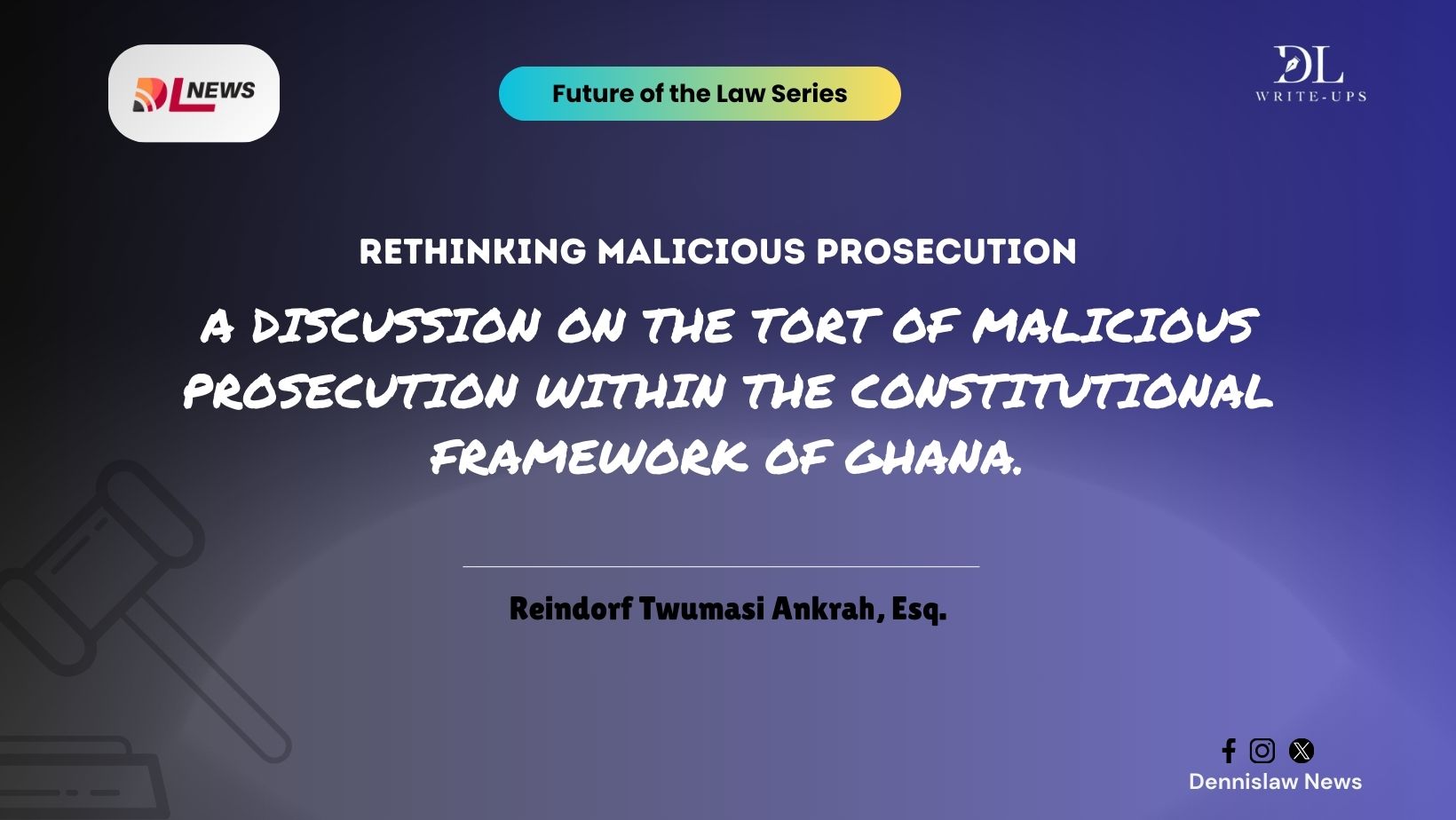
Rethinking Malicious Prosecution; A Discussion on the Tort of Malicious Prosecution within the Constitutional Framework of Ghana.
The article argues that the tort of malicious prosecution, as received under common law, is problematic in present-day Ghana under Article 88. The author suggests that the proper defendant in such cases should be the Attorney General, who i...
ABSTRACT
Malicious prosecution is a tort which finds application in many common law countries such as Ghana. However, in the light of Article 88, it becomes questionable whether the scope of the tort as it exists at common law must and can be applied in present day Ghana without modifications.
In this paper, the author argues that, considering Article 88, the application of the tort of malicious prosecution in its pure form as was received under common law is problematic and therefore some modifications ought to be made to bring the tort in line with the constitution. He suggests that the proper defendant to a Malicious Prosecution action ought to be the Attorney General and not the complainant who has no say as to whether or not there is a probable cause for a criminal prosecution.
Introduction
The constitution of the Republic of Ghana is the Supreme law of the land and where any other law is found to be inconsistent with the constitution, the said law shall be void[1].
It is worthy of note that, prior the coming into force of the Constitution mentioned above, the country Ghana existed and was governed by a set of laws ranging from, customary law, common law, Acts of Parliament among others. These laws are referred to as existing law under the present constitution and derive their validity and application under the present constitution, based their consistency with the present constitution.[2]
As a result of the Supreme Court Ordinance of 1876, the common law, doctrines of equity and statutes of general application which were in force in England on 24th July 1874, were to be in force within the jurisdiction of the Ghanaian court. The common law from which we have the Tort of Malicious prosecution forms part of the common law and existing law of Ghana and therefore by the constitutional provisions referenced, applicable in Ghana.
However, the question arises as to whether the common law tort as existed and adopted as applicable in Ghana in 1876 can be applied in its pure form and scope under the 1992 Constitution of Ghana and if so who should bear the liability for malicious prosecution.
Before attempting an answer to the question posed above, it is important to take step back into time to look at the tort of malicious prosecution, what it entails and some modifications made to it in the United Kingdom which I describe as the motherland of the common law.
What is the tort of malicious prosecution
The roots of malicious prosecution can be traced back to England, finding early expressions in the writ of conspiracy during Edward I's reign.[3] The tort of malicious prosecution arises when an individual, acting with malice and lacking reasonable and probable cause, initiates legal proceedings against another. For the tort to apply, these proceedings must conclude in favour of the defendant/accused person, resulting in damage to their reputation, person, or property.
The concept of malicious prosecution took shape in the seventeenth century. Initial cases clarified that an action could only be brought if an indictment had been maliciously and unjustly pursued. In the Saville[4] case, judges expanded the scope meaning and scope of conspiracy and defined civil remedies for the emerging tort of malicious prosecution. Malicious prosecution, therefore, became available in cases where scandal, punishment, or expense befell the victim, even if the grand jury rejected the charge or the indictment was defective.[5]
As with all torts, for a claim to succeed in an action for malicious prosecution, the claimant must establish certain conditions (elements). The judicial decisions and scholarship on this tort agree on what the elements to be established in a successful claim for malicious prosecution are[6]. These elements are briefly discussed below;
- The defendant prosecuted or was 'actively instrumental' in instituting criminal proceedings against the claimant.
This requires the claimant/Plaintiff to establish that, the defendant is responsible for the prosecution. In establishing this, the claimant ought to demonstrate that, the defendant either conducted the prosecution herself, or the defendant procured, instigated, directed, ordered or was actively instrumental in the prosecution[7].
- That the proceedings must have terminated in favour of the claimant.
Under this leg of the conditions, the claimant must demonstrate that she was acquitted and discharged of the offence. To achieve this task, the claimant only needs to show one of these, that she was acquitted of the specific charge even if convicted of a lesser offence, claimant's conviction in a lower court was quashed or set aside on appeal due to procedural irregularities, that the prosecution either discontinued or withdrew the proceedings even if reserving the right to recommence or that the Attorney-General issued a nolle prosequi, staying further proceedings on the indictment[8].
- That the defendant acted without reasonable and probable cause.
Plaintiff must demonstrate from the facts that the defendant to the claim, prosecuted her without reasonable and probable cause. What constitutes reasonable and probable cause has been explained asan honest belief in the guilt of the accused based upon full conviction, founded upon reasonable grounds, of the existence of a state of circumstances, which, assuming them to be true, would reasonably lead any ordinarily prudent and cautious man, placed in the position of the accuser, to the conclusion that the person charged was probably guilty of the crime imputed. See Hicks v. Faulkner[9].
- That the defendant acted maliciously.
Malice in this context is not limited to only ‘spite’ or ‘ill-will’, but also any motive other than a desire to bring a criminal to justice. The question then is, whether the defendant in instigating the prosecution, had a purpose other than that which is believed to be right in the interests of justice.
- That the claimant suffered damage to his reputation, person or property.
Actual damage is essential. The kinds of damage upon which a claimant may rely are damage to fame, damage to a person, or property damage.
It is an incontestable principle of the law that, the most crucial question that the claimant in an action founded on malicious prosecution must answer is whether the defendant in the action was/is the prosecutor. This question is not one which has lent itself easy to answer and a study of the judicial authorities reveals that several and serious effort and mental exercise has been committed to creating an elastic concept of a prosecutor in order to accommodate some of the objections or questions raised in defence to actions founded on malicious prosecution. In Danby v. Beardsley[10], Lopes J defined a prosecutor, for the purposes of the tort of malicious prosecution, as a person "actively instrumental in putting the law in force".
In trying to ascertain the scope of what constitutes actively instrumental in putting the law in force, it has been argued that, where a defendant lays information before a magistrate charging the plaintiff with a criminal offence, the defendant will be liable as a prosecutor if the other requirements of the tort are satisfied. Since information is usually laid by the police and not by private citizens, the proper defendant in such circumstances will most often be the individual police officer who laid the information or the responsible police authority.[11]
It has further been argued that, since it is the police officer who signs the charge sheet charging the accused with an offence, if a private individual signs the charge sheet, he may be liable as a prosecutor, although the prosecution is technically conducted not by him but by the police.[12]
Who is the prosecutor within the context of Article 88[13]
In the respectful view of the author, the pivot of the tort of malicious prosecution is the need to show by evidence that the defendant was indeed the prosecutor. It is submitted that, this element is the first in the scheme of things to be established such that, once the claimant fails in this regard, there will be no need to proceed further with the case. It is therefore important at all times to demonstrate that, the defendant to the claim is/was indeed the prosecutor. in this regard, the discussion in this paper will focus on analysing who qualifies as the prosecutor within the context of Ghana.
This paper has partly been inspired by the decision of his Lordship Justice Ernest Owusu Dapaah (PhD) a justice of the Court of Appeal sitting as an additional High Court judge in the case of Anthony Osarfo v. Asamoah Gyan and Samuel Anim Addo[14]. This case involves the famous former blackstars football team captain Asamoah Gyan where the Court held Gyan liable for maliciously prosecuting the Plaintiff in the said suit. Unfortunately, the Court was not called upon to evaluate the effect of article 88 on the common law jurisprudence on who qualifies as a prosecutor for the purposes of malicious prosecution. The Court therefore, relying on the common law principles of who is a prosecutor, concluded that, Gyan had maliciously prosecuted the Plaintiff in the said case.
It is submitted that, had the Court adverted its mind to the said provisions of the law, it may have arrived at a different conclusion on the relevant question of who was the prosecutor.
Article 88 of the 1992 Constitution establishes the position of the Attorney-General, who is a Minister of State and Principal Legal Advisor to the Government. The Attorney-General is responsible for initiating and overseeing all prosecutions of criminal offences on behalf of the State/Republic. For the purpose of this paper, the relevant provisions of article 88 of the Constitution which are clauses (3) & (4) provide as follows:
“(3 )The Attorney-General shall be responsible for the initiation and conduct of all prosecutions of criminal offences.
(4) All offences prosecuted in the name of the Republic of Ghana shall be at the suit of the Attorney-General or any other person authorised by him in accordance with any law.’’
The operative words used in the provisions cited above especially relating to prosecution, are initiation and conduct. The words, initiate and conduct are not defined by the constitution. However, the simple English dictionary definition offered are that, initiate means to begin something, to make something begin whereas to conduct means to lead or guide; to manage, or to control[15].
Once the definitions are imported into the test of the provisions cited above, it becomes crystal clear that within the context of Ghana, the Attorney General is responsible for beginning, leading or controlling of criminal prosecution and all such prosecutions shall be at the instance of the Attorney General or with the authority of the Attorney General[16].
In Ghana, the established practice is that, criminal prosecutions are carried out by State Attorneys, who are part of the Office of the Attorney-General. Aside the state Attorneys working in the office of the Attorney General, the Attorney General may appoint any public officer to prosecute a case on her behalf. For instance, some personnel of the Ghana police, labour officers among others, can prosecute certain offences, but in all these cases, the Attorney General has oversight responsibility and directs the conduct of the case and can take over the prosecution at any time.
Generally, criminal proceedings in Ghana begin with the police, who conduct investigations into criminal complaints and the alleged offenders are charged by the Republic with the offences the Republic considers appropriate given the facts of the complaint.
By the dictates of the 1992 Constitution, the right to initiate criminal proceedings vests exclusively in the Attorney-General. A private person or individual cannot initiate a criminal action against an accused person but will have to rely on the Attorney General. If the Attorney General believes that a criminal suspect should not face prosecution, the victim or complainant cannot compel prosecution and a decision by the Attorney General to prosecute or otherwise is not subject to any judicial enquiry or questions. In other words, the exercise of the discretion of the Attorney General to prosecute or not, cannot be questioned or be made a subject of judicial review.
The final decision to prosecute or not, lies with the Attorney General whose decision in this regard cannot be challenged or questioned. The Attorney General, is therefore the only person clothed with the power to start and conduct prosecutions in Ghana. We must note that the power vested in the Attorney General involves the exercise of varied acts of discretion such as the discretion to initiate or not to initiate prosecution and even in cases where the prosecution has commenced to discontinue same, discretion to call a particular witness or not among others. Considering the enormous powers of the Attorney General in criminal prosecution, the question which arises then is, whether a complainant should be held responsible or considered the prosecutor for the purpose of malicious prosecution for a prosecution initiated or conducted by the Attorney General who is not subject to the direction or control of the complainant or victim and whose prosecutorial decisions the complainant or victim cannot even question.
After a criminal complaint is lodged with the Police, the appropriate state institutions tasked to investigate and prosecute, which includes the Attorney General and her officers, are required to make their own diligent enquiries and investigations into the complaint before taking a decision to prosecute. This decision is made in most cases without the consent or concurrence of the complainant who may not even have a proper understanding of the operations or functional requirements of the said institutions.
A complainant who may later become a defendant in a malicious prosecution suit, has very little to no influence on the shape and form the prosecution must take and as such within the context of Ghana, it will be unfair and unjust to refer to the complainant as the prosecutor for purposes of malicious prosecution given the state of the law and practice of criminal prosecution in Ghana.
The argument against holding a complainant or victim of a crime liable for malicious prosecution is further buttressed by the learning that, criminal prosecution terminating in favour of the accused, does not necessarily mean that the complaint was without reasonable cause or malicious. Several factors can be implored to explain why a criminal prosecution in a particular instance was unsuccessful and this may range from logistical support to human factors such as the incompetence of the prosecutor in charge of the prosecution, poor investigation, corruption or some inactions or actions of the prosecutor.
A victim of a crime or any other person may lodge a complaint under section 61 of Act 30[17] and where required, act as a prosecution witness. However, beyond these roles, the victim has little or no further involvement in prosecuting the offender. It therefore is an aberration of justice, good conscience and equity for the complainant to be held responsible for a decision which is the exclusive preserve of the Attorney General.
Anyone familiar with the criminal prosecution set of the Republic of Ghana will know that, mostly or in all cases, the complainant has very little to no control over how the investigations are conducted and how the trial is conducted among others. The entire architecture of the criminal prosecution, relegates the complainant to the background and she may only come in as a witness for the state at best. This point was echoed in very clear and unequivocal language by the Court in the case of Mbrah v Johnson[18]where the Court succinctly circumscribed the role of the complainant in a criminal prosecution by the Republic as follows;
“in criminal prosecutions by the Republic, a complainant could have some interest, but he or she was principally and invariably merely a witness. She could not decide in which court the prosecution of the case was to be conducted. Her interest in the fairness of the trial was submerged into the dominant interest of the Republic. His or her interest was not one which could enable him or her to appeal against the decision of the court if she felt aggrieved. The accused on the other hand was a principal party. Consequently, a complainant in a criminal case prosecuted in the name of the Republic was not "any person concerned" within the language of section 100 (1) of Act 372 and could not therefore bring an application for the transfer of the suit.”
It is argued that, being part of the existing laws of Ghana, the tort of malicious prosecution must be applied with the requisite modifications to bring it into conformity with the constitution. Once this is done, we will be left in no doubt that within the constitutional context of Ghana, a complainant cannot be considered the prosecutor for whatever purpose and as such cannot be liable for malicious prosecution nor even be made a defendant in such a suit.
It is further argued that, considering the present state of Ghana law, we need to take a second look at the continuous application of the tort of malicious prosecution in its pure form as received under the common law since this practice among other factors, clearly undermines the office of the Attorney General by implicitly suggesting that, the Attorney General is subject to or could be subject to the control and direction of a complainant in the discharge of the power exclusively vested in the Attorney General by the constitution.
Conclusion
It is the argument of the author that, based on the law and structure of the criminal justice system in Ghana, the reference to the complainant as the prosecutor for the purposes of malicious prosecution is inconsistent with the express provisions of the article 88 of the constitution. The Constitution, as the supreme law of the land, takes precedence over common law. Accordingly, the tort of malicious prosecution, which holds a private individual liable as a prosecutor in specific situations, contradicts Article 88 of the 1992 Constitution and that within the context of Ghana, the prosecutor should be the Attorney General.
It is suggested that, if we want to continue with the existing practice and application of the tort of malicious prosecution without modifications, then there will be a need for a legislation or constitutional amendment to allow private prosecutions by victims of crime. In such a case, the private person, shall be responsible for taking the decision to prosecute and conducting the prosecution of the alleged victim and in that situation, it will be fair and just to hold the victim or private person liable for malicious prosecution.
[1] Constitution of Ghana, 1992 Article 1(2).
[2] Constitution of Ghana, 1992 Article 11(1)(2)(4) & (5).
[3] Douglas Hay, Prosecution and Power: Malicious Prosecution in the English Courts, 1750-1850 (1989)
[4] Saville v Roberts (1698) 12 Mod Rep 208
[5] Douglas Hay, Prosecution and Power: Malicious Prosecution in the English Courts, 1750-1850 (1989)
[6] Kofi Kumado. Introduction to the Law of Torts in Ghana. (2nd edn. Black Mask, 2009).
[7] Soadwah v. Obeng [1966] G.L.R. 338
[8] Boaler v. Holder (1867) L.R. 2 C.P. 684
[9] (1881) 8 QBD 167
[10] (1880) 43 LT 603
[11] Gilbert Kodilinye, Setting in Motion Malicious Prosecutions: The Commonwealth Experience (1987): The International and Comparative Law Quarterly, Vol. 36, No. 1 (Jan., 1987), pp.157-168, Cambridge University Press.
[12] ibid
[13] Constitution of Ghana, 1992.
[14] Anthony Osarfo vs. Asamoah Gyan and Samuel Anim Addo [2023] DLHC16836
[15]“Conduct.” “Initiate.” Merriam-Webster.com Dictionary, Merriam-Webster, https://www.merriam-webster.com/dictionary/conduct. Accessed 7 Jun. 2024.
[16] Gregory Afoko v. Attorney General; Writ No. J1/8/2019 judgment delivered on 19 June 2019.
[17] Criminal and Other Offences (Procedure) Act,1960 (Act 30), Sec. 61
[18] [1973] 2 GLR 213