LawyersOpinion
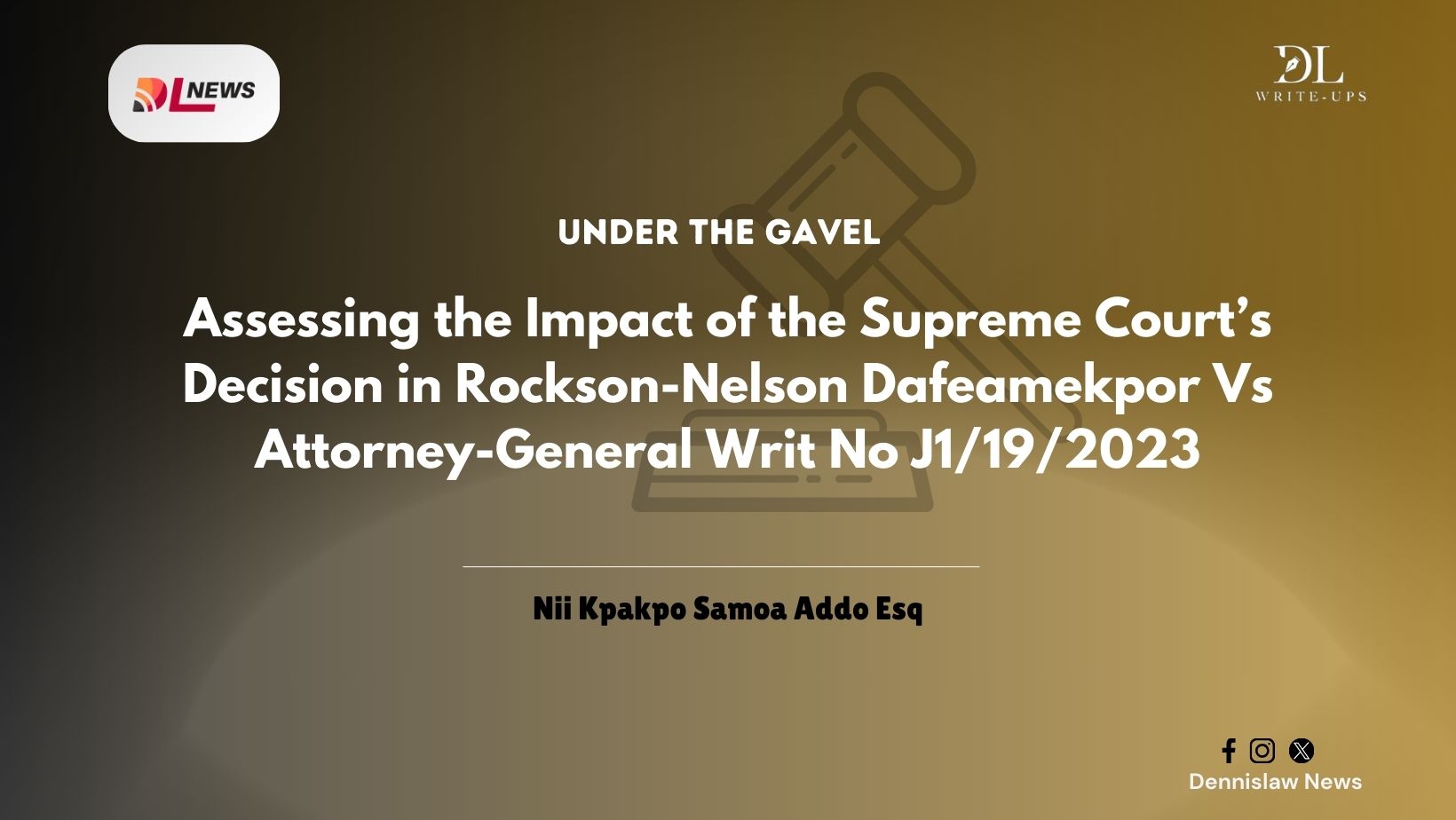
Under the Gavel: Assessing the Impact of the Supreme Court’s Decision in Rockson-Nelson Dafeamekpor Vs Attorney-General Writ No J1/19/2023
This article critiques the Supreme Court's decision in Rockson-Nelson Dafeamekpor vs. Attorney-General, which addressed the President's directive allowing Metropolitan, Municipal, and District Chief Executives (MMDCEs) to remain in office i...
INTRODUCTION
On 11th January 2021, the President issued a directive with reference SCR/DA39/314/401 to all Metropolitan, Municipal and District Chief Executives (MMDCEs) who were in office before the presidential inauguration on 7th January 2021 to remain at post until further notice.
This directive was issued in accordance with Article 243(3) of the 1992 constitution of the Republic of Ghana. The directive also purported to prohibit the MMDCEs from making policy-related decisions in line with Section 14(5) of Act 843.
It is against the above actions of the President of the Republic that Mr. Rockson-Nelson Dafeamekpor in his capacity as a citizen of Ghana initiated an action invoking the original jurisdiction of the Supreme Court under Articles 2(1) and 130(1) of the 1992 Constitution challenging the constitutionality of the directive issued by the President of the Republic.
The Supreme Court in a unanimous decision held that the directive issued by the President of the Republic did not order the removal of all MMDCEs and did not direct them to continue in their roles in an acting capacity.
I respectfully disagree with the Supreme Court’s decision in ROCKSON-NELSON DAFEAMEKPOR VS ATTORNEY-GENERAL WRIT NO J1/19/2023. It is my submission that the court missed an opportunity to uphold its duty to enforce the 1992 Constitution.
The reasons for my submission above are as follows:
- The Supreme Court failed to fulfill its constitutional mandate to enforce the 1992 Constitution.
- The Supreme Court evaded the essential issue presented before it (the legal effects of the directive issued by the President).
- The decision sets a concerning precedent for governance in the country.
At this point, I will examine the following:
- The appointment and removal process for Metropolitan, Municipal, and District Chief Executives (MMDCEs).
- The role of the President of Ghana in appointing and removing MMDCEs.
- The constitutionality of acting MMDCEs under the 1992 Constitution.
- The case presented to the court, including the arguments made by both the plaintiff and defendants .
- The court's ruling and its implications.
APPOINTMENT AND REMOVAL OF MMDCES.
The position or office of a Metropolitan, Municipal or District Assembly Chief Executive is a creation of the 1992 Constitution, and is also part of the broader decentralization and local governance architecture enshrined in chapter 20 of the 1992 Constitution.
As such, all matters relating to the appointment, tenure or term of office, emoluments and removal from office of Metropolitan, Municipal and District Assembly Chief Executives are determined, governed and regulated by the 1992 Constitution itself because such matters are specifically catered for by the 1992 Constitution, any act or decision relating to such matters must strictly comply with the relevant provisions of the Constitution that specifically deal with such matters, else the act or decision will be deemed inconsistent with the Constitution and consequently null and void and of no legal effect.
The Supreme Court has held in Ghana Bar Association v Attorney-General (Abban case)[1] and Yeboah v J.H. Mensah[2] that when the Constitution provides a specific method or procedure or remedy in going about or dealing with a particular matter, it is that particular procedure that must be adopted and no other else.
Therefore, if any person or body is dealing with a matter that is specifically provided for by the Constitution, that person or body must ensure that his actions or decisions are precisely in line or compliant with the relevant provisions of the Constitution that deals with the matter. That person or body cannot resort to any other procedure outside that provided for by the Constitution else his action or decision will be held by the Supreme Court to be unconstitutional and therefore null and void and of no legal effect.
Article 243(1) of the 1992 Constitution prescribes the mode or procedure for the appointment of Metropolitan, Municipal and District Assembly Chief Executives. The said Article specifically provides that
“there shall be a District Chief Executive for every district who shall be appointed by the President with the prior approval of not less than two-thirds majority of members of the Assembly present and voting at the meeting.”
On the term or tenure of office of Metropolitan, Municipal and District Assembly Chief Executives, Article 246(2) provides that
“unless he resigns or dies or he earlier ceases to hold office under clause (3) of Article 243 of this Constitution, the term of office of the District Chief Executive shall be four years; and a person shall not hold office as a District Chief Executive for more than two consecutive terms.”
Article 243(3) of the 1992 Constitution the office of a Metropolitan, Municipal and District Assembly Chief Executive becomes vacant under the following circumstances:
“(a) if a vote of no confidence, supported by the votes of not less than two-thirds of all the members of the District Assembly is passed against him; or (b) if he is removed from office by the President; or (c) if he resigns or dies
It can be gleaned from Articles 243(1), 246(2) and 243(3) of the 1992 Constitution that the appointment, tenure or term of office and the removal of Metropolitan, Municipal and District Assembly Chief Executives are clearly prescribed and provided for by the Constitution.
Consequently, when one is dealing with matters pertaining to the appointment, removal from office or tenure or term of office of a Metropolitan, Municipal and District Assembly Chief Executive, one must look at the relevant provisions of the Constitution which govern same to direct one’s actions.
It must again be emphasised that the office of the Metropolitan, Municipal and District Assembly Chief Executive is a creation of the 1992 Constitution and therefore the Constitution can be properly described as its “Constitutive Act”. Therefore, in line the Supreme Court’s decision in Theophilus Donkor v Attorney General[3] one would have to turn to the Constitution in order properly determine matters pertaining to the appointment, tenure or term of office and removal of Metropolitan, Municipal and District Assembly Chief Executives.
THE REMOVAL AND APPOINTMENT OF MMDCEs BY THE PRESIDENT OF GHANA
The President of the Republic by a Presidential directive and in exercise of his powers under Article 243(3)(b) of the 1992 Constitution removed all Metropolitan, Municipal and District Assembly Chief Executives who were at post immediately before the issuance of the said directive from office on 11th January, 2021.
The President then directed the said Metropolitan, Municipal and District Assembly Chief Executives to continue in office in an acting capacity until further notice.
THE CONCEPT OF ACTING MMDCE’S
The concept of an acting Metropolitan, Municipal and District Assembly Chief Executive is alien to the 1992 Constitution.
The Constitution empowers the President to appoint Metropolitan, Municipal and District Assembly Chief Executives under Article 243(1). Per Article 243(1) the President can only appoint Metropolitan, Municipal and District Assembly Chief Executives with the prior approval of not less than two-thirds majority of members of the District Assembly present and voting. This means that the President cannot suo motu appoint Metropolitan, Municipal and District Assembly Chief Executives without the prior approval of the Members of Assembly.
Article 243(1)of the 1992 Constitution makes the prior approval by members of the Assembly a condition precedent to the appointment of Metropolitan, Municipal and District Assembly Chief Executives. Consequently, no person can purport to act or hold himself out as a Metropolitan, Municipal and District Assembly Chief Executive when that person has not received the prior approval of the Members of the Assembly to which that person purports to act as a Metropolitan, Municipal and District Assembly Chief Executive.
The wording of Article 243(1) is similar to that of Article 78(1). Article 78(1) of the 1992 Constitution deals with the appointment of Ministers of State. Per Article 78(1) the President can only appoint Ministers of State with the prior approval of Parliament. Both Articles 243(1) and 78(1) of the 1992 Constitution put fetters on the appointing powers of the President. Under Article 243(1), the President can only appoint Metropolitan, Municipal and District Assembly Chief Executives with the prior approval of not less than two-thirds majority of members of the District Assembly present and voting. Similarly, under Article 78(1) the President can only appoint Ministers of State with the prior approval Parliament.
The Supreme Court had the opportunity to pronounce on the meaning and effect of “prior approval” in the case of J.H. Mensah v Attorney General[4].
The Supreme Court made it emphatically clear in the J. H Mensah case referred to supra that the prior approval of Parliament in the appointment of Ministers of State is a condition precedent that the President must at all times meet.
In line with the Supreme Court’s decision in the J. H. Mensah case, It is respectfully submitted that the prior approval of the Members of the District Assembly is a condition precedent to the appointment of Metropolitan, Municipal and District Assembly Chief Executives, and therefore the President cannot purport to appoint or direct or instruct Metropolitan, Municipal and District Assembly Chief Executives to continue in office in an acting capacity without the prior approval of the Members of Assembly.
The President cannot remove a Minister of State from office and then subsequently re-appoint the same Minister back into the same office in an acting capacity without the prior approval of Parliament. In the same vein, the President cannot remove Metropolitan, Municipal and District Assembly Chief Executives from office and then purport to re-appoint them back in office in an acting capacity without the prior approval of the Members of Assembly. That is simply illegal and unconstitutional.
There is no express provision in the Constitution that allows the President to suo motu appoint or direct or instruct Metropolitan, Municipal and District Assembly Chief Executives to continue in office in an acting capacity, neither does Article 243(1) of the 1992 Constitution admit of such an interpretation.
The wording of Article 243(1) of the 1992 Constitution is deliberate. The primary intent and purpose of the whole of chapter 20 of the 1992 Constitution is to encourage participatory democracy at the local level and to provide for a system of decentralized local government. It is for this reason that the Constitution by Article 243(1) caps or limits the President’s appointing powers with respect to Metropolitan, Municipal and District Assembly Chief Executives.
The concept of an acting Metropolitan, Municipal or District Assembly Chief Executive is not only foreign to the 1992 Constitution but also dangerous. It allows the President to circumvent the laid down procedure prescribed by Article 243(1) of the 1992 Constitution to impose any person of his choosing upon the District Assemblies without their prior input and approval. If allowed to persist, the President can decide to allow these acting Metropolitan, Municipal and District Assembly Chief Executives to continue in office for the whole of his tenure in office. This defeats the whole purpose of encouraging participatory democracy at the local level as envisioned under chapter 20 of the Constitution.
Given the procedure laid down in Article 243(1) of the 1992 Constitution for the appointment of Metropolitan, Municipal and District Assembly Chief Executives and the decentralized local governance architecture envisioned under chapter 20 of the Constitution, it is submitted that the President cannot suo muto appoint, instruct or direct persons to hold office as Metropolitan, Municipal and District Assembly Chief Executives in an acting capacity without the prior approval of the Members of Assembly.
THE PLAINTIFF’S CASE
The Plaintiff contended that:
- The directive issued by the President of the Republic of Ghana, under article 243 (3), directing all MMDCEs to continue in office was unconstitutional. That the said directive was issued under article 243 (3), it can be reasonably inferred that the President purported to exercise his power under article 243(3) (b) to remove from office all MMDCEs who were at post immediately before the issuance of the said directive.
- Having removed them, they were, per the directive, to remain in office until further notice. The office of MMDCEs is specifically provided for under Chapter 20 of the 1992 Constitution of Ghana. As such, matters regarding the appointments, tenure, emoluments and removal from office must comply with the constitutional provisions to be valid.
- Article 243 (1) provides that the President shall appoint the District Chief Executives (DCEs) with the prior approval of not less than two thirds majority of members of the Assembly present and voting at the meeting.
- Article 246 (2) provides that unless the MMDCE resigns or dies or ceases to hold office under clause (3) of article 243, the term of office is four years and shall not hold office for more than two consecutive terms.
- Article 243 (1) of the constitution makes the prior approval by members of the Assembly a condition precedent to the appointments of MMDCEs. Consequently, no person can purport to act or hold himself out as MMDCE when that person has not received prior approval from the members of the Assembly.
- The wording of article 243 (1) is similar to that of Article 78 (1), which requires parliamentary prior approval to appoint a Minister of State. And Articles 243(1) and 78 (1) of the 1992 Constitution puts fetters on the appointing powers of the President.
- The President cannot purport to remove a Minister of State from office and then subsequently re-appoint the same minister back into the same office in an acting capacity without parliamentary prior approval. In the same vein, the President cannot remove MMDCEs from office and then purport to re-appoint them into office in acting capacities without the prior approval of members of the Assembly.
- The power to suo motu appoint MMDCEs has not been expressly granted to the President, nor can it be implied under article 243 (1). Thus, the concept of acting MMDCEs is not only foreign to the constitution but also dangerous in that it allows the President to circumvent the laid down procedure under article 243 (1) to impose any person he desires on the District Assemblies against the law, which in turn defeats the whole concept of participatory democracy as envisioned under chapter 20 of the Constitution.
- Furthermore, the President also instructed the acting Metropolitan, Municipal and District Assembly Chief Executives “not to take a decision involving a policy” in accordance with section 14(5) of the Presidential (Transition) Act, 2012 Act 843.
- The schedule to section 14 of the Presidential (Transition) Act, 2012 Act 843 specifically provides for persons holding certain offices whose tenure of office end at the assumption of officeof a new elected president. Metropolitan, Municipal and District Assembly Chief Executives do not fall under this category; therefore section 14(5) of the Presidential (Transition) Act, 2012 Act 843 does not apply to them.
- The tenure or term of office of a Metropolitan, Municipal and District Assembly Chief Executive is not tied to that of the President and therefore Metropolitan, Municipal and District Assembly Chief Executives continue to hold office pursuant to section 14(3) Presidential (Transition) Act, 2012 Act 843 and Article 246(2) of the 1992 Constitution.
- The President exceeded his power by the said directive under article 243 (3). Hence, the continued stay in office of the affected MMDCEs was unlawful and unconstitutional. Consequently, all agreements or contracts entered into and decisions made by the MMDCEs were unlawful.
THE DEFENDANT’S CASE
The Defendant also contended that:
- The President did not appoint anyone to hold office as DCE or MMCE without prior approval by the respective Assemblies.
- The appointment of a DCE is anchored on Article 243(1) but contended that the President has not made any nominations for Article 243 (1) to be triggered.
- The President has implied powers to direct or instruct persons suitable to act as his representative when the office of a DCE has become vacant. The President has implied powers to aska suitable person to act for a reasonable time until a substantive appointment is made. The Defendant relied on the case of J.H. Mensah v Attorney General[5], Articles 57(1), 58 (1), and (3) and 297(a). In this light, the defendant argued that the President, as the head of government and in the name of his executive authority, can authorize officers subordinate to him to exercise executive authority per article 58 (3).
- As head of government, the President has the authority to appoint public officers. Under Article 297 (a), the President can direct that such persons so appointed hold the office in an acting capacity.
- That a close reading of the Constitution shows that the purpose for the appointment of DCEs is to represent the President at the local level of governance. And as DCEs, they are charged with the day to day performance of executive and administrative functions of the District Assemblies in accordance with Article 243 (2). Therefore, reading Articles 243 (1) 246, 57 (1), 58 (1)(3) purposively warrants a conclusion that where the office of a DCE becomes vacant, the President has the power to instruct or direct any person he deems fit to act temporarily as he contemplates a substantial appointment. This will ensure the local representation of the President at all material times to ensure government business continues.
- That the office of the DCE is a public office within the context of Article 190 (1), and any interpretation that precludes the President from directing a person to act as DCE in the meantime would mean an absence of central government and for that matter executive authority at the local level.
ISSUES THE PARTIES AGREED ON TO BE RESOLVED BY THE SUPREME COURT
The parties filed a joint memorandum on 1st July 2022 on the following issues:
- Whether upon a true and proper interpretation of article 243 (1) and 246 (2) of the 1992 Constitution, the President of the Republic has power or authority to instruct or direct Metropolitan, Municipal and District Chief Executives to remain in office in an acting capacity after expiration of their term of office.
- Whether the Presidential directive dated 11th January 2021, with reference number SCR/DA 39/314/01 directing Metropolitan, Municipal and District Chief Executives to continue in office in an acting capacity contravenes Articles 243 (1) and 246 (2) of the 1992 Constitution and is therefore null and void and of no effect.
- Whether upon a true and proper interpretation of article 243 (1) and 246 (2) of the 1992 Constitution all agreements or contracts entered into by persons acting as Metropolitan, Municipal and District Chief Executives are binding on the Republic of Ghana.
- Whether the Plaintiff’s action is moot.
- Whether the President has implied power or authority to instruct or direct a suitable person to act as his representative in a District Assembly where the office of the District Chief Executive is vacant.
DECISION OF THE SUPREME COURT
The Supreme Court in a unanimous decision held that
“in the present case, there is no perceived threat to the Constitution. Instead, the springboard of the plaintiff's claim is the Presidential directive, which allegedly directed all MMDCEs to continue in office in an acting capacity. The directive did not order the removal of all MMDCEs and did not direct them to continue in their roles in an acting capacity.Consequently, the plaintiff's contention that the directive instructed MMDCEs to continue in their offices in an acting capacity lacks merit”[6].
It is important to reproduce and note this portion of the court’s decision which provides the reasoning behind the court’s holding that the directive did not order the removal of all MMDCEs and did not direct them to continue in their roles in an acting capacity.
The Supreme Court reasoned that
“The clear meaning of these provisions is that the MMDCEs term of office is fixed at four years from the date of approval by the Assembly, renewable consecutively once. However, the Assembly may pass a vote of no confidence, or the President may remove an MMDCE from office during their term. Until these events occur, a person appointed as an MMDCE continues in office for four years”[7].
The Supreme Court further held that
“We have taken judicial notice of the fact that the appointment of the MMDCEs by the President takes months after the President is sworn into office. We have also taken judicial notice of the fact that the approval process by the Assembly runs into weeks and, in some cases, months, with some approval processes going into a second and third round of voting. As such, the starting and ending point for calculating the four-year tenure of the MMDCEs differ depending on when twothirds of the Assembly approved them”[8].
On the issue of the directive from the President, the court was reasoned that
“It follows that all MMDCEs in office at the time of Exhibit DNR1 had a right to remain in their positions as their term had not ended, and no vacancies had occurred. If Exhibit DRN1 did not remove from office the MMDCEs who were at post on the 7th of January 2021 when the President was sworn into office, they could not have been requested to act in the office once their tenure had not expired. In our opinion, the directive from the Office of the President to the MMDCEs “to remain at post until further notice” was unnecessary because their tenure of office was not tied to that of the President”[9].
CRITIQUE OF THE SUPREME COURT’S DECISION
The Supreme Court failed to fulfill its constitutional mandate to enforce the the 1992 Constitution:
It is a well-established principle in democratic societies that the judicial arm of government is revered as the guardian of country’s constitution, entrusted with the sacred responsibility of interpreting, enforcing and protecting the supreme law of the land[10]. The 1992 Constitution is the supreme law of Ghana[11]. The Constitution, 1992 gives the judiciary power to interpret and enforce the Constitution, 1992[12].Subject to the jurisdiction of the High Court in the enforcement of the Fundamental Human Rights and Freedoms, the Supreme Court shall has exclusive original jurisdiction in all matters relating to the enforcement of the 1992 Constitution among other things[13].
The Supreme Court is also empowered to make declarations and orders when enforcing the 1992 Constitution[14]. In discussing the enforcement jurisdiction of the Supreme Court under Articles 2(1) and 130(1) of the 1992 Constitution, I will rely on the dictum of Atuguba JSC in the case of Emmanuel Noble Kor vrs The Attorney General & Justice Isaac Delali Duose,
“It will be seen that article 2 of the Constitution is headed “Enforcement of the Constitution” and the ensuing provisions are meant to attain the enforcement of the Constitution. There is therefore express authority in the Constitution itself for the view that the enforcement jurisdiction of this court is a conspicuously independent item of jurisdiction of this court. Indeed, though it will be erroneous to say that a declaratory action cannot be brought within article 2 towards the enforcement of an ambiguous provision of the Constitution, it appears that while the enforcement purpose of that article is clear on the face of its provisions, its interpretative purpose is comparatively latent”[15].
It has repeatedly been made clear that under Articles 2(1) and 130(1) of the Constitution, the enforcement jurisdiction of the court is one part of its exclusive original jurisdiction, while the interpretative jurisdiction is the other[16].
The Supreme Court was called upon to give effect to the directive issued pursuant to Article 243(3) of the 1992 Constitution. The court’s reasoning that the directive from the Office of the President to the MMDCEs “to remain at post until further notice” was unnecessary because their tenure of office was not tied to that of the President”[17] is instructive. The Supreme Court was not called upon to determine the necessity or otherwise of the President’s directive but rather to enforce the constitution by giving effect to the directive issued by the President in exercise of his constitutional mandate under Article 243(3) of the 1992 Constitution, which allows the President to remove MMDCE’s from office. The Supreme Court failed to exercise its constitutional mandate under Articles 2(1) and 130(1) of the 1992 Constitution to enforce the Constitution.
The Supreme Court evaded the essential issue presented before it (the legal effects of the directive issued by the President):
It is noteworthy that the issues surrounding the tenure and renewal of Metropolitan, Municipal and District Assembly Chief Executives' mandates were not disputed. The court's statement that “All MMDCEs in office at the time of Exhibit DNR1 had a right to remain in their positions as their term had not ended, and no vacancies had occurred[18]” is instructive.
However, the right to remain in office as an MMDCE is not absolute, but rather subject to among other things the President's constitutional mandate under Article 243(3) of the 1992 Constitution to remove them from office.
Respectfully the court’s conclusion that the directive from the President did not remove the MMDCE’s from office is inaccurate. The directive was issued by the President in exercise of his constitutional mandate under, which allows the President to remove MMDCE’s from office. A directive issued by the President under Article 243(3) of the 1992 Constitutionis to remove the MMDCE’s from office.
The question remains as to the effect of the President's directive issued under Article 243(3), which the Supreme Court failed to address, thereby neglecting to uphold the provision that formed the basis of the directive.
The decision sets a concerning precedent for governance in the country :
Precedents have a profound impact on the development of the law and the functioning of the legal system[19]. A precedent may serve as a guide or a justification for deciding subsequent cases[20]. The establishment of a precedent has far-reaching consequences, shaping the course of future legal decisions and influencing the behavior of legal actors[21]. The decision in question may embolden future attempts to circumvent constitutional provisions and undermine the constitution . As Justice Scalia warned, A precedent is not merely a decision; it is a decision that is intended to be followed in future cases[22].
This decision will embolden Presidents in exercising their executive power to circumvent the laid down procedure prescribed by Article 243(1) of the 1992 Constitution to impose any person of his choosing upon the District Assemblies without their prior input and approval. If allowed to persist, the President can decide to allow these acting Metropolitan, Municipal and District Assembly Chief Executives to continue in office for the whole of his tenure in office. This defeats the whole purpose of encouraging participatory democracy at the local level as envisioned under chapter 20 of the Constitution.
CONCLUSION
From the discussion so far, I submit that the Supreme Court failed to evaluate the substance of the legal issues presented to it specifically the legal effects of the directive issued by the President in accordance with Article 243(3) of the 1992 constitution of the Republic of Ghana.
My conclusion is premised on the following :
- The Supreme Court failed to fulfill its constitutional mandate to enforce the 1992 Constitution.
- The Supreme Court evaded the essential issue presented before it (the legal effects of the directive issued by the President).
- The decision sets a concerning precedent for governance in the country..
[1] [2002-2004]1 SCGLR at 259
[2] [1998-99] SCGLR 492
[3] unreported writ no. J1/08/2017 dated 12th June, 2019
[4] [1996-97] SCGLR 320
[5] (1996- 19997) SCGLR
[6]Pages 17 & 18
[7] Pages 17 & 18
[8] Pages 17 & 18
[9] Pages 17 & 18
[10] Alexander Hamilton in Federalist No. 78 (1788)
[11] Article 1(2) of the 1992 Constitution
[12] Archer CJ in NEW PATRIOTIC PARTY V. ATTORNEY-GENERAL (1994) JELR 66360 (SC)
[13] Article 130(2) of the 1992 Constitution
[14] Article 2(2) of the 1992 Constitution
[15] (2015-2016] 1 SCGLR 114
[16] Sumaila Bielbiel v. Dramani (No 1) [2011] 1 SCGLR 132, Kor v. Attorney General & Anor, Kan II & Ors v. Attorney-General & Ors [2015-2016] 1 SCGLR 691, Annan & Anor v. Attorney General WRIT NO. J1/14/2019 (Dated 31st March 2022) (unreported).
[17] Supra1 page 15
[18] Page 15
[19] Rosenberg, M. (1991). The Precedent Process: A critical analysis of Pennsylvania Law Review, 139(4), 921-956
[20] Cross, R. (1991). Precedent in English Law. Oxford University Press.
[21] Baum, L. (1986). The Supreme Court and the Political Process. American Political Science Review, 80(2), 341-354.
[22] Scalia, A. (1997). A matter of Interpretation: Federal Courts and the Law. Princeton University Press.