A-G challenges GBA over partisanship and uneven stance on constitutional debates
By DL news
Published
2 min read
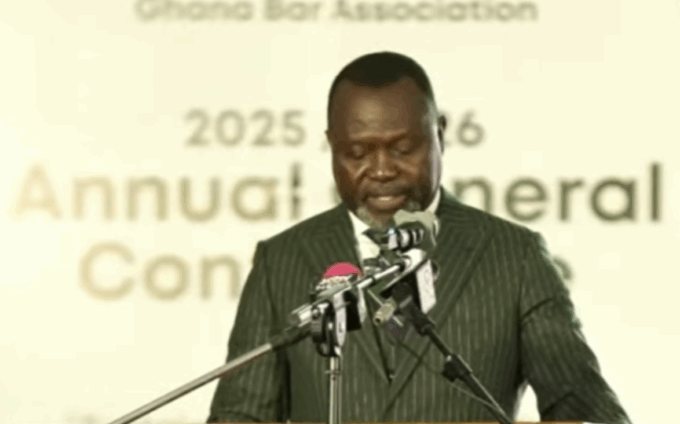
Addressing members at the GBA’s annual conference in Wa, Dr Ayine said he was disappointed by what he described as the association’s lack of consistency in its approach to constitutional matters.
Attorney-General Dr Dominic Ayine has taken aim at the Ghana Bar Association (GBA), accusing the body of abandoning neutrality and drifting into partisan advocacy.
Addressing members at the GBA’s annual conference in Wa, Dr Ayine said he was disappointed by what he described as the association’s lack of consistency in its approach to constitutional matters.
“We must remember that our allegiance is first and foremost to the constitution and this republic, not to transient political interests,” he told participants.
He noted that “our republic has tested and continues to test the resilience of its democratic institutions. In doing this, the Bar has played a crucial role in assisting the Supreme Court to interpret and enforce the Constitution. But outside the courtroom, the advocacy of the Bar as a professional group has lacked consistency, bringing into question its adherence to principles.”
According to Dr Ayine, the association has not always demonstrated fairness in its interventions, often sounding more like an opposition voice than a neutral professional body.
He argued that the GBA had become “self-serving”, prioritising its own interests over those of the wider legal community and the public.
The Attorney-General cited past instances to highlight what he viewed as selective silence. He recalled the absence of criticism from the GBA during the removal of former Electoral Commission Chairperson Mrs Charlotte Osei and her deputies, contrasting this with its vocal position on the removal of Chief Justice Gertrude Torkornoo.
“When in 2015 an Article 146 petition was received by the Chief Justice in relation to the former Chairperson of the Commission on Human Rights and Administrative Justice, Madame Loretta Lampe, the Bar failed to speak out about the process,” he said.
He continued: “In the run-up to the 2016 election, the then-opposition New Patriotic Party engaged the Electoral Commission in court battles over the voter identification system. This gave rise to the Abu Ramadan line of cases. Immediately upon assuming office in 2017, an Article 146 petition was filed for the removal of the Chairperson of the Electoral Commission, Mrs Charlotte Osei, and her deputies from office. The Bar saw no basis to speak out about compliance with due process.”
Dr Ayine added that the GBA only found its voice more recently in relation to petitions concerning the removal of the former Chief Justice, Mrs Gertrude Torkornoo.
“The honest question we have to ask ourselves is, what changed? The three petitions concerned officeholders of critical constitutional bodies. The independence of these institutions is guaranteed by the Constitution, and all three occupants were women of repute and members of our noble profession. Yet, the Bar found its voice only in relation to the third petition. Coincidentally, the voice of the Bar amplified the voice of the opposition,” he remarked.