Citizen challenges false news and electronic communication laws at Supreme Court
By DL News
Published
Updated
2 min read
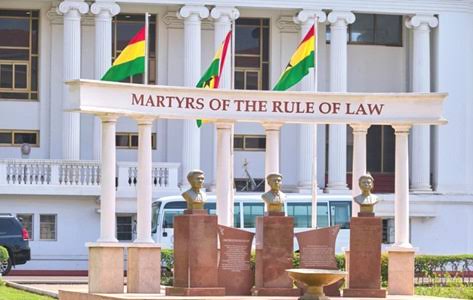
Austin Kwabena Brako-Powers filed the suit at the Supreme Court Registry in Accra through his lawyer, Michael Akosah of Adu-Gyamfi & Associates.
A Ghanaian citizen has gone to the Supreme Court seeking to strike down laws he says unlawfully restrict freedom of speech, expression and the press.
Austin Kwabena Brako-Powers filed the suit at the Supreme Court Registry in Accra through his lawyer, Michael Akosah of Adu-Gyamfi & Associates.
The Attorney-General has been named as the sole respondent.
At the centre of the case is Section 208(1) of the Criminal Offences Act, 1960, Act 29.
That provision criminalises the publication of statements, rumours or reports likely to cause fear and alarm to the public or disturb public peace.
Mr Brako-Powers argues that the law is vague, too broad and places unjustifiable limits on rights protected under the 1992 Constitution.
He says the provision violates Article 21(1)(a), which protects freedom of speech and expression, Article 21(1)(b), which protects freedom of thought, and Article 162, which guarantees media freedom.
The plaintiff is also challenging Section 208(2) of Act 29.
That subsection requires an accused person to prove that reasonable steps were taken to verify the accuracy of a publication.
According to him, this wrongly shifts the burden of proof onto the accused and violates the presumption of innocence under Article 19(2)(c) of the Constitution.
He argues that the law can expose journalists, media practitioners and ordinary citizens to criminal prosecution even where they did not deliberately or recklessly publish false information.
The suit also targets Section 76(1) of the Electronic Communications Act, 2008, Act 775.
That provision criminalises the sending of false or misleading electronic communications.
Mr Brako-Powers says the law does not define clearly what amounts to a false or misleading communication.
He argues that this lack of precision makes the provision inconsistent with Article 19(11) of the Constitution, which requires criminal offences to be clearly defined.
He is asking the court, in the alternative, to interpret Section 76(1) narrowly.
He wants it to apply only to knowingly false communications intentionally sent to endanger life or disrupt life-saving services, rather than mistaken, negligent or opinion-based communications.
The plaintiff is also challenging Section 76(2) of Act 775.
That subsection imputes knowledge of falsity to a person who fails to take reasonable steps to verify a communication.
He argues that this also reverses the burden of proof and undermines the presumption of innocence.
According to the court documents, the subsection treats an accused person as knowing that a communication was false merely because the person allegedly failed to verify it.
Mr Brako-Powers says the challenged provisions are also inconsistent with Ghana’s international human rights obligations, including duties under the International Covenant on Civil and Political Rights.
He argues that Article 40 of the Constitution requires Ghana to respect such obligations.
The plaintiff is seeking 11 reliefs from the Supreme Court.
Among them is a declaration that continued prosecution, threatened prosecution or investigation of any person under Section 208 of Act 29 for exercising constitutional freedoms is unconstitutional and void.
He is also asking the court to strike down Sections 208(1) and 208(2) of Act 29, as well as Sections 76(1) and 76(2) of Act 775, as unenforceable.