Full Ruling: Why Supreme Court rejected Oppong Nkrumah’s legal vacation trial injunction
By DL News
Published
Updated
5 min read
The Supreme Court rejected Kojo Oppong Nkrumah’s injunction application after finding no law prohibiting criminal trials during the legal vacation and no evidence that the Chief Justice’s warrants were discriminatory or improperly issued. T...
The Supreme Court’s refusal to halt criminal trials during the legal vacation rested on a central conclusion: Kojo Oppong Nkrumah did not demonstrate a sufficiently strong constitutional case to justify suspending an administrative arrangement which the Court considered to be advancing the public interest.
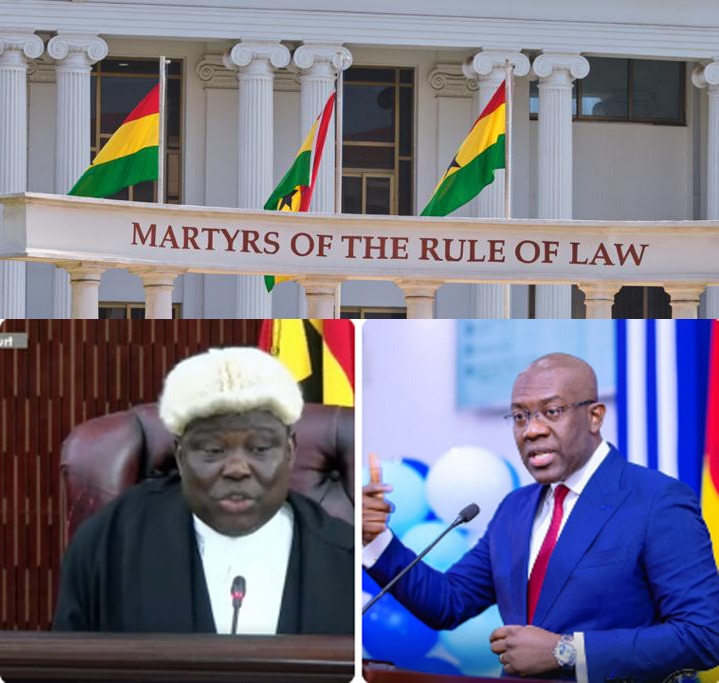
Justice Gabriel Pwamang, sitting as a single Justice of the Supreme Court, rejected the Ofoase-Ayirebi MP’s application for an interlocutory injunction on Friday, August 21, 2026.
The application sought to restrain the Chief Justice and two High Court judges from giving effect to warrants authorising the judges to sit during the legal vacation. It was filed within a substantive action challenging the constitutionality of the warrants.
The refusal of the injunction does not finally determine that substantive case. It means that the criminal proceedings covered by the warrants may continue while the larger constitutional challenge remains pending.
The starting point of the ruling was the legal test governing interlocutory injunctions.
Ordinarily, an applicant must demonstrate that there is a serious question to be tried, that refusing the injunction could cause irreparable harm and that the balance of convenience favours preserving the existing position.
Justice Pwamang, however, emphasised that courts exercise particular caution where an injunction would suspend official action presumed to have been undertaken in the public interest.
Drawing on decisions including Welford Quarcoo v Attorney-General, Michael Ankomah-Ninfah v James Gyakye Quayson and Republic v High Court; Ex parte Ghana Lotto Operators Association, the Court held that a person seeking a public law injunction must first show that the substantive claim has very high prospects of success.
It was at this initial stage that Mr Oppong Nkrumah’s application encountered its principal difficulty.
A significant part of the constitutional challenge was based on the contention that the Chief Justice had authorised the hearing of selected criminal cases while other cases were left unattended.
The Court found that characterisation factually inaccurate.
Justice Pwamang held that the warrants did not identify individual cases for preferential treatment. Rather, they authorised the two judges concerned to hear all cases pending before their respective courts.
This distinction was decisive. The Court treated the arrangement as the selection of courts to operate during the vacation, rather than the selection of particular accused persons or prosecutions for special treatment.
That finding weakened the argument that the warrants amounted to selective justice.
The applicant relied substantially on Article 17 of the 1992 Constitution, which guarantees equality before the law and prohibits discrimination on specified grounds.
The Court accepted that the warrants meant cases pending before the two authorised judges could be heard earlier than criminal matters before other judges. It nevertheless held that a difference in the timing of cases did not, without more, establish inequality before the law.
More importantly, no allegation or evidence connected the warrants to gender, race, colour, ethnic origin, religion, creed or social or economic status—the grounds expressly identified under Article 17(2).
The Court therefore concluded that the Article 17 argument did not raise the serious constitutional question necessary to support an interlocutory injunction.
Mr Oppong Nkrumah also invoked Articles 23 and 296, which require administrative bodies and public officials to act fairly, reasonably and without arbitrariness, caprice or bias when exercising discretionary power.
But the ruling noted an important concession: the applicant accepted that the Chief Justice possessed the authority to issue warrants allowing judges to sit during the legal vacation. The real complaint concerned the manner in which that discretion was exercised.
According to the Court, challenging that exercise required more than showing that only two courts had been authorised to sit. There had to be evidence pointing to improper purpose, ill will or another constitutionally prohibited consideration.
The breadth of cases handled by the specialised courts—including narcotics, cybercrime, galamsey, Auditor-General surcharge, corruption and related matters—made it difficult, in the Court’s assessment, to infer that the arrangement targeted any particular class of accused persons.
Another limb of the action was that vacation sittings could adversely affect the health and welfare of judges, Judicial Service staff and lawyers, contrary to Articles 24 and 36(10).The Court found that argument unpersuasive.
Justice Pwamang said judges who work during the legal vacation ordinarily take their leave after the courts resume. Court staff did not lose their leave entitlement merely because they assisted with vacation sittings.
The ruling also described lawyers as independent service providers who could arrange their leave at different periods of the year.
The Court consequently found no factual foundation for treating vacation hearings as a violation of constitutionally protected working conditions.
Perhaps the ruling’s most consequential finding concerned the legal status of the court vacation itself.
Order 79 of the High Court (Civil Procedure) Rules, 2004 (C.I. 47) regulates the hearing of civil cases during the legal vacation. But the proceedings targeted by the injunction were criminal trials.
The Court held that neither the Courts Act, 1993 (Act 459) nor the Criminal and Other Offences (Procedure) Act, 1960 (Act 30) prescribes a legal vacation during which criminal trials are prohibited.
Although criminal courts have developed a practice broadly following the civil vacation calendar, the Court found no binding statute or precedent preventing the Chief Justice from authorising High Court criminal proceedings during that period.
The applicant’s concession that the Chief Justice possessed the underlying authority made it even harder to identify an existing legal right requiring temporary protection.
The balance of convenience ultimately favoured keeping the courts open.
Article 19(1) guarantees a person charged with a criminal offence a fair hearing within a reasonable time. Article 14(4) also recognises the consequences of unreasonable delay where an accused person remains in custody.
Justice Pwamang interpreted the warrants as an attempt to expand the opportunity for criminal cases to be determined expeditiously.
The fact that every criminal case in the High Court could not be heard during the vacation did not, in the Court’s view, justify preventing those cases which could be heard from progressing.
That reasoning turned the applicant’s equality argument on its head. For the Court, halting the proceedings would not create equal access to vacation hearings; it would merely prevent any of the affected cases from moving forward.