Thousands flee Gaza City as Israeli military advances
By DL news
Published
Updated
3 min read
According to Israel, its mission is to dismantle what it calls Hamas’s “last stronghold,” eliminate as many as 3,000 fighters, and rescue its hostages.
Large numbers of Palestinians continue to escape Gaza City after Israel announced the launch of a full-scale ground assault aimed at seizing control of the city.
The Hamas-run health ministry reported that the al-Rantisi children’s hospital was struck three times during heavy overnight bombardments, forcing half of its patients and families to evacuate.
Israel’s army confirmed it was reviewing those claims, though it said earlier that over 150 “terror targets” across Gaza City had been attacked in just two days.
According to Israel, its mission is to dismantle what it calls Hamas’s “last stronghold,” eliminate as many as 3,000 fighters, and rescue its hostages.
The campaign has sparked broad condemnation worldwide.
More than 20 humanitarian organisations have urged immediate global action, saying “the inhumanity of the situation in Gaza is unconscionable” and demanding “urgent intervention”.
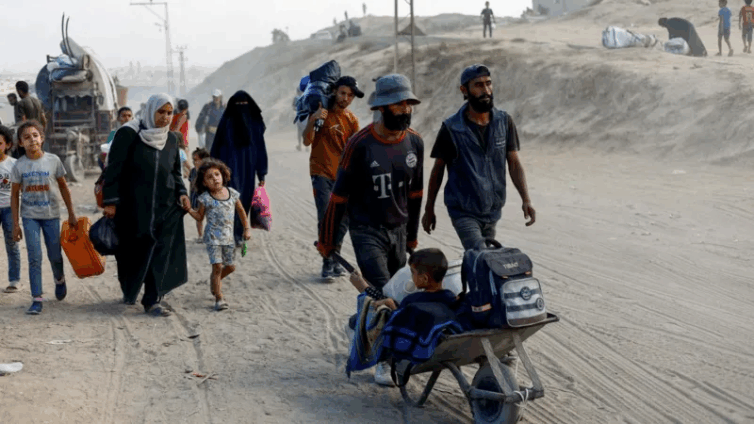
For several days, endless streams of displaced residents have been heading south in donkey carts, rickshaws, overpacked vehicles, and on foot.
Until this week, the only permitted route was a coastal road leading to an Israeli-designated “humanitarian area” in al-Mawasi.
On Wednesday, however, the Israel Defense Forces (IDF) said a second passage via the central Salah al-Din road would be opened for 48 hours starting at midday.
Even so, many families say they cannot afford the journey. Renting a truck can cost up to 3,000 shekels ($900; £660), while a tent for five people sells for roughly 4,000 shekels.
Lina al-Maghrebi, a 32-year-old mother of three from Sheikh Radwan, told the BBC:
“I was forced to sell my jewellery to cover the cost of displacement and a tent.”
“It took us 10 hours to reach Khan Younis, and we paid 3,500 shekels for the ride. The line of cars and trucks seemed endless.”
Aid groups warn that al-Mawasi is already overwhelmed, with nowhere near the resources to accommodate the estimated two million people expected to be forced there. Some evacuees who obeyed the IDF’s instructions say they returned north after failing to find space to set up tents.
According to the IDF, roughly 350,000 people have left Gaza City, while UN figures put the number at 190,000 since August. Estimates suggest some 650,000 remain.
Reports in Israeli media suggest the military is using obsolete vehicles rigged with explosives and remotely driven into Hamas sites before detonation.
Meanwhile, relatives of 48 hostages still in captivity 20 of whom are thought to be alive demonstrated near Prime Minister Benjamin Netanyahu’s home in Jerusalem.
“All day long, you boast about killing and destruction,” said Macabit Mayer, aunt of Gali and Ziv Berman. “Bringing down buildings in Gaza - who are you bringing these buildings down on? Could it be that you are bringing these buildings down right now on Gali and Ziv and all the souls left there - the living and the deceased?”
UN human rights chief Volker Türk branded the assault “totally and utterly unacceptable,” while UK Foreign Secretary Yvette Cooper described it as “utterly reckless and appalling”.
By contrast, US Secretary of State Marco Rubio signalled backing for Israel during a press appearance with Netanyahu. He said that although Washington preferred a negotiated settlement,
“sometimes when you’re dealing with a group of savages like Hamas, that’s not possible”.
A UN Commission of Inquiry has also determined that Israel committed genocide in Gaza. The findings accused Israeli forces of using sexual and gender-based violence, intentionally killing children, and mounting a “systemic and widespread attack” on religious, cultural, and educational institutions.
Israel’s foreign ministry dismissed the conclusions as “distorted and false”.
The conflict began after the Hamas-led incursion into southern Israel on 7 October 2023 that killed about 1,200 people and saw 251 taken hostage.
Since then, Gaza’s health ministry says at least 64,964 have been killed, nearly half women and children.
With famine already declared in Gaza City by a UN-backed food security body, the UN has warned that the intensification of Israel’s military campaign could push civilians into “even deeper catastrophe”.