
Opinion
Legal Vacation Without ‘Vacation.’; The Plight of ‘ORAL ’ Lawyers and the Infringed Rights of the Accused?
Frederick Gurah Sampson
200 results.
Opinion
Frederick Gurah Sampson



Opinion
This article examines the judicial powers of the Judicial Committee of a Traditional Council in Ghana, outlining its composition, jurisdiction, appointment process, and adjudicatory functions in chieftaincy disputes. It also discusses appea...
Richard Appiah Kubi
Opinion
The article examines the Justice for All Programme at Kumasi Central Prison in 2025 as a practical justice-sector intervention that brings courts into prison settings to review remand cases, grant or vary bail, and reduce prolonged pre-tria...
Emmanuel Brobbey

Opinion
A lecture delivered at the KNUST Law Faculty on 23rd March, 2023
Mariam Agyeman Gyasi Jawhary
Opinion
This article argues that whilst Ghana’s statutory criminal law (via the Criminal Offences Act 1960 (Act 29) governs codified offences, it fails to formally recognise many customary offences and sanctions entrenched in Ghanaian communities....
Kofi Annan and Nana Adwoa Serwaa Dua-Adonteng Esq.

Opinion
The article explores how AI is reshaping Ghana's legal system, emphasizing both its efficiency benefits and the ethical and procedural risks it poses. It concludes that while AI can aid legal processes, it cannot replace human judgment, and...
Elizabeth Asantewaa Ofori and Goodnuff Appiah Larbi
Opinion
This lecture argues that justice in Ghana must extend beyond courts into homes, schools, communities, and public institutions, where dialogue, fairness, and accountability are first learned and practised. It contends that a peaceful and sta...
Justice Paul Baffoe-Bonnie
Opinion
The article examines whether a sentence imposed in absentia begins from the date it is pronounced or from when the convicted person is brought into custody. Using the Sedina Tamakloe-Attionu case, the author argues that a purposive reading...
Frederick Gurah Sampson
Opinion
This writer submits that the Ogyeadom case could never, as perceived by the Court, have settled the question whether or not the Court is jurisdictionally competent to entertain and grant an application for stay of execution pending the dete...
Thaddeus Sory

Opinion
This article examines the process of becoming a judge in Ghana, outlining the recruitment procedures, conditions of service, postings, transfers, leadership expectations, and the exclusivity of judicial roles. It provides insights into the...
Bertha A. Aniagyei

Opinion
This second part of the article explores the challenges judges in Ghana face after assuming office, including external pressures, political interference, social reclusiveness, security risks, and mental health struggles. It highlights the e...
Bertha A. Aniagyei
Opinion
The article explores the subject of ex gratia paid to Article 71 office holders and questions its relevance under Ghana's socioeconomic situation and the legal principle of Nemo Dat Quod Non Habet
Frederick Gurah Sampson

Opinion
It has always been the established practice of the courts that dates for hearing applications are fixed by the respective Registrars of the courts in the registries in which the applications are filed. This is done at the time of filing suc...
Thaddeus Sory, Esq.
Opinion
This article examines judicial review of administrative actions in Ghana, focusing on the cases Ex Parte Ernest Thompson and Ex Parte Hoda Holdings Limited. It analyzes the distinction between the High Court's supervisory and judicial revie...
Kenneth Atsu Dogbey & Martin Waana-Ang
Opinion
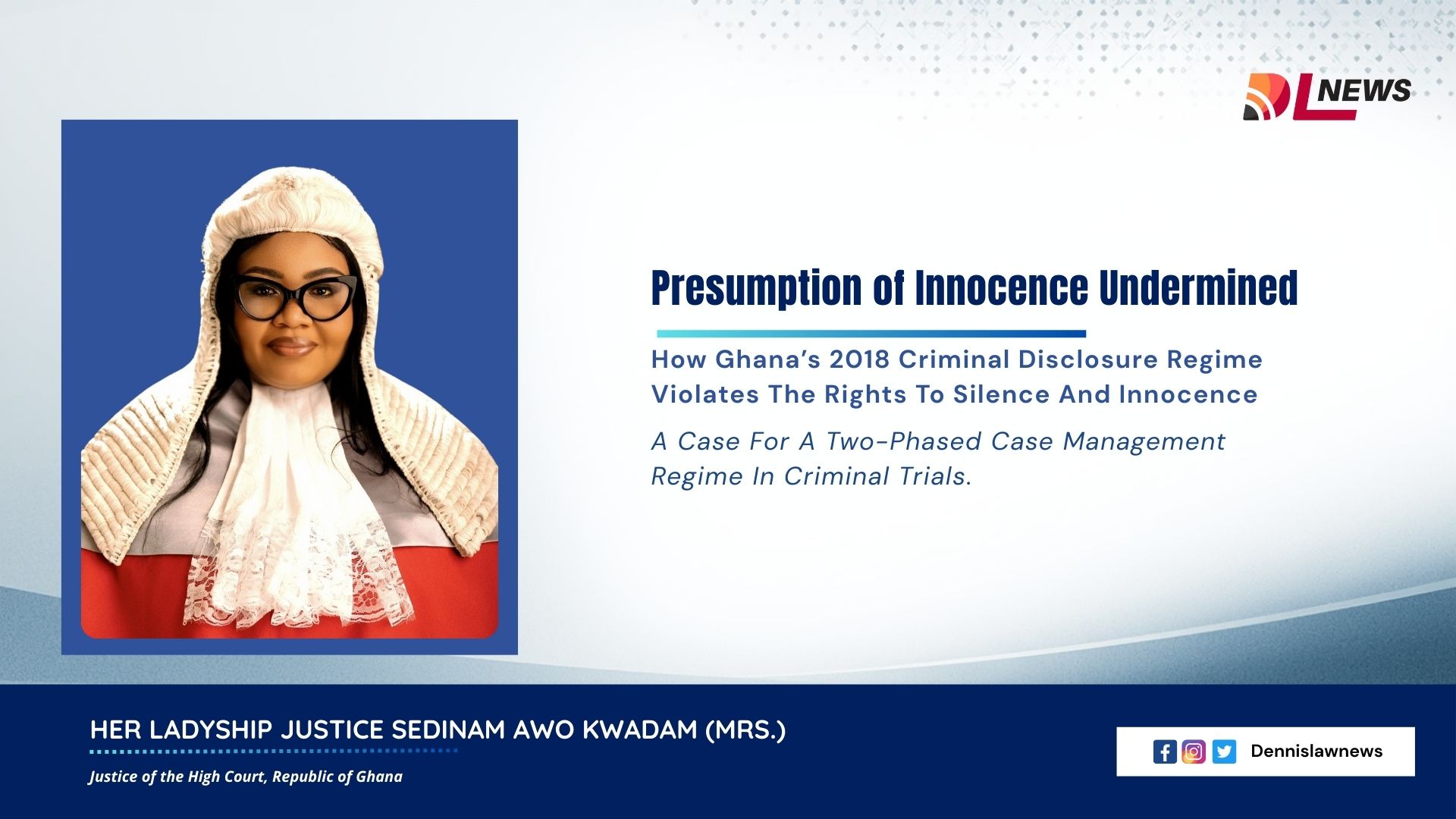
This article argues that Ghana’s 2018 Criminal Disclosure and Case Management Practice Directions, though aimed at efficiency, fundamentally undermine the presumption of innocence and the right to silence by compelling premature defence dis...
Sedinam Awo Kwadam

Opinion
The interesting subject of Blue laws is the focus of this article, including its applications in Ghanaian law
Justice Alexander Osei Tutu
Opinion
This paper seeks to discuss the general right to counsel, its current application in Ghana, and how the right is central to the effective administration of plea bargaining.
E. K. Bidzakin