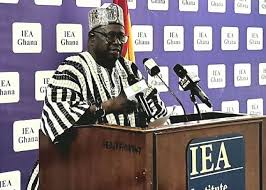
Call for papers for academic work reflecting Tsatsu Tsikata's contribution to Ghanaian Law
By DL News
Published
Updated
3 min read
For over half a century, Tsatsu Tsikata has operated at the intersection of academia, high-impact litigation, and statecraft. From mentoring generations of legal minds at the University of Ghana to shaping landmark constitutional and human...
A formal call for papers has been issued for a new edited scholarly volume titled Law, Development, and the Pursuit of Justice: Scholarly Reflections on Tsatsu Tsikata’s Contributions to Ghanaian Law
For over half a century, Tsatsu Tsikata has operated at the intersection of academia, high-impact litigation, and statecraft. From mentoring generations of legal minds at the University of Ghana to shaping landmark constitutional and human rights jurisprudence, and from laying foundational frameworks in Ghana’s petroleum sector to generating a seminal body of case law through his own prosecution and acquittal, Mr. Tsikata’s career has consistently influenced the trajectory of Ghanaian law.
Despite this extensive footprint, the volume's editors note a critical gap in the literature. While individual cases and episodes have been widely discussed, there is no single, comprehensive academic work that critically evaluates the cumulative impact of Mr. Tsikata’s contributions on justice, governance, and legal development. This book seeks to close that gap by consolidating scholarly reflections into a coherent, peer-reviewed reference work.
The Call for Papers is structured around three strategic contribution tracks.
The first invites case-centered analyses of matters in which Mr. Tsikata acted as counsel, spanning early constitutional litigation, chieftaincy disputes, financial and commercial law, election petitions, and contemporary Supreme Court practice. Contributors are encouraged to situate these cases within their sociolegal and political context and to assess their doctrinal and systemic implications.
The second track focuses on the “Tsikata Cases” arising from his prosecution, which generated far-reaching jurisprudence on fair trial rights, judicial power, constitutional vagueness, appellate supervision, and the legal consequences of presidential pardons. These cases remain touchstones in Ghanaian constitutional and criminal procedure law and continue to inform judicial reasoning.
The third track turns to energy and natural resources governance, an area in which Mr. Tsikata played a formative role during his tenure as CEO of the Ghana National Petroleum Corporation. Contributions under this category may interrogate regulatory design, foreign investment frameworks, contract negotiation, fiscal regimes, transparency, and Ghana’s experience in international energy-related disputes.
Across all categories, the editors are explicitly prioritizing interdisciplinary and comparative approaches, welcoming analyses grounded in economics, political theory, sociology, philosophy, development studies, and international practice. The strategic objective is not hagiography but critical engagement that stress-tests ideas, outcomes, and institutional choices.
Abstracts of no more than 400 words, accompanied by a short bio or CV, are due by 16 March 2026, with full papers expected by 1 June 2026. Selected chapters will undergo peer review, and the finalized manuscript is scheduled for submission to an international academic publisher by December 2026, with discussions underway with major presses, including Palgrave Macmillan.
The editors of the volume—drawn from leading academic, judicial, and professional institutions—frame the project as both a scholarly intervention and a long-term resource. In their view, the volume will serve not only as a retrospective on an extraordinary legal career but also as a forward-looking platform for interrogating how law mediates power, development, and justice in Ghana.
For Ghanaian legal scholarship, the Call for Papers represents a high-leverage opportunity: to consolidate doctrine, contextualize history, and recalibrate debates that continue to shape constitutionalism, governance, and resource management today.
Submission Guidelines and Key Dates
Proposals to contribute a chapter to the book may be submitted in accordance with the following guidelines and timelines:
(a) An interested contributor should submit an abstract of not more than 400 words, along with a bio of 150 words or a one-page CV, to editor.tsikatabook@gmail.com no later than 16 March 2026.
(b) Authors of selected abstracts will be notified by 26 March 2026. The deadline for submitting full papers is 1 June 2026.
(c) Full papers should be in the range of 7000 to 8000 words, including footnotes, and should comply with the Oxford Standard for the Citation of Legal Authorities (OSCOLA).
(d) Contributions will be subjected to peer review before inclusion in the manuscript. The finalized manuscript will be submitted to the publisher by December 2026. Editors are engaging with publishers, including Palgrave Macmillan (of the Springer Nature Group), for this purpose.
Requests for information or clarifications may be sent to editor.tsikatabook@gmail.com
Download the document to read for further details and guidelines.