Know the current LLb-awarding institutions in Ghana: Their history and locations
By DL News
Published
Updated
12 min read
From the University of Ghana, which pioneered university-based legal education in the country, to relatively new law faculties established in different parts of Ghana, prospective law students now have a wider range of institutions to consi...
Ghana's legal education system has undergone considerable expansion over the years, with the opportunity to pursue a Bachelor of Laws (LLB) degree no longer confined to a handful of universities.
From the University of Ghana, which pioneered university-based legal education in the country, to relatively new law faculties established in different parts of Ghana, prospective law students now have a wider range of institutions to consider.
The expansion has involved public universities, private universities, faith-based institutions and international university partnerships, some of which have introduced law programmes several decades after their establishment.
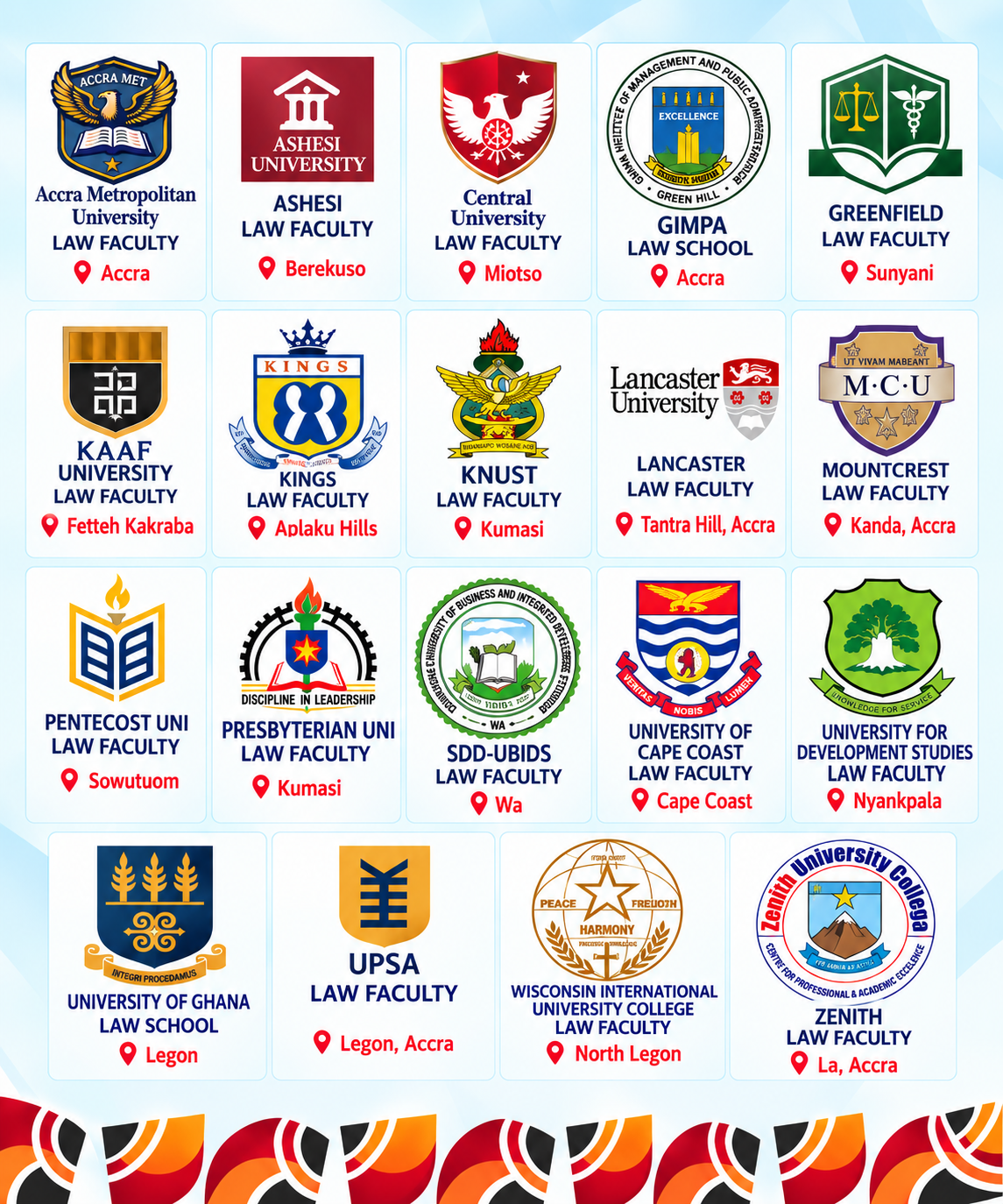
In June 2026, the General Legal Council (GLC), working within Ghana's legal education regulatory framework, identified 19 law faculties and institutions under interim arrangements for the delivery of LLB and Pre-Bar programmes.
The development followed reforms introduced under the Legal Education Act, 2026 (Act 1170), which seek to broaden access to professional legal training and address longstanding difficulties associated with the transition from university legal education to professional qualification.
The arrangements are intended to allow recognised institutions to play a greater role in legal training, subject to the applicable regulatory and accreditation requirements.
For prospective students, however, knowing the name of a university is only part of the picture. Its history, location and the period in which it began offering legal education may also be useful considerations.
It is particularly important to distinguish between the year an institution was established and the year its law faculty or LLB programme commenced operations.
A university founded several decades ago may have introduced legal education only recently.
DL News takes a closer look at the 19 institutions named in the June 2026 arrangements, their locations and the history behind their development.
1. Accra Metropolitan University — Accra, Greater Accra Region
Accra Metropolitan University is a private tertiary institution located in Accra.
Its institutional history can be traced to Laweh Open University College, which was established in 2014 to provide flexible tertiary education through conventional and technology-supported learning methods.
The institution subsequently developed into Accra Metropolitan University as part of efforts to expand its academic programmes and institutional reach.
Its School of Law is among the institutions identified in the June 2026 legal education arrangements.
Although the institution traces its origins to 2014, the exact year in which its School of Law commenced the LLB programme has not been independently established from the available historical records.
2. Ashesi University — Berekuso, Eastern Region
Ashesi University was established in 2002 by Patrick Awuah, a former Microsoft executive, with the aim of providing a distinctive model of higher education focused on leadership, critical thinking and ethical responsibility.
The university began operations in Accra with 30 students before relocating to its permanent campus at Berekuso in the Eastern Region in 2011.
It received its presidential charter in 2018, becoming an independent degree-awarding university.
Although Ashesi has existed since 2002, its entry into legal education came much later.
In October 2024, the university announced that it had received approval from the Ghana Tertiary Education Commission and the General Legal Council to introduce its Bachelor of Laws with Public Policy programme.
The programme combines traditional legal studies with public policy and governance, providing students with an interdisciplinary approach to legal education.
3. Central University — Miotso, Greater Accra Region
Central University traces its beginnings to a pastoral training institution established by the International Central Gospel Church in 1988.
It subsequently developed into Central Bible College in 1991 and Central Christian College in 1993.
In 1998, it became Central University College as its academic programmes expanded beyond theological education.
The institution received a presidential charter in 2016, attaining the status of an independent university.
Today, Central University operates its main campus at Miotso, along the Accra–Aflao road in the Greater Accra Region.
Its Law School forms part of the university's expansion into professional and academic disciplines outside its original religious training mandate.
4. Ghana Institute of Management and Public Administration (GIMPA) — Greenhill, Accra
The Ghana Institute of Management and Public Administration is one of Ghana's established public tertiary institutions.
Founded in 1961 as the Institute of Public Administration, GIMPA was initially created to develop the administrative and managerial capacity of Ghana's public service.
Over the years, it expanded its programmes to include business administration, governance, public management and other professional disciplines.
Its Law School was established in 2010, marking another stage in the institution's academic development.
Located at Greenhill in Accra, GIMPA's legal education programmes are offered within an institution with longstanding experience in public administration, governance and leadership training.
5. Greenfield College — Sunyani, Bono Region
Greenfield College is a private tertiary institution located in Sunyani in the Bono Region.
The institution traces its origins to the College of Science, Arts and Education, established in 2016.
It subsequently developed under the Greenfield name, broadening its academic programmes and institutional objectives.
Its Faculty of Law is included among the institutions identified under the June 2026 legal education arrangements.
The available institutional history establishes 2016 as the year of the college's origins, but the specific year in which its law faculty began offering the LLB programme requires further confirmation.
6. KAAF University — Fetteh Kakraba, Central Region
KAAF University was founded in 2006 and began admitting students during the 2008/2009 academic year.
Located at Fetteh Kakraba in the Central Region, the institution initially concentrated on engineering, business and other professional programmes.
It subsequently expanded into additional disciplines, including law.
In 2020, KAAF introduced law and political science programmes, initially through an affiliation arrangement with GIMPA.
The institution received its presidential charter in 2024, becoming an independent degree-awarding university.
Its introduction of legal education represents part of the broader participation of private universities in Ghana's university law programmes.
7. Kings University College — Aplaku Hills, Greater Accra Region
Kings University College was established in February 2009 and received institutional accreditation in January 2010.
The institution began with a relatively small student population, initially offering postgraduate business education before expanding into other disciplines.
Its Faculty of Law, Governance and International Relations reflects the institution's interest in connecting legal studies with governance and international affairs.
Kings University College is located at Aplaku Hills, near Weija in the Greater Accra Region.
8. Kwame Nkrumah University of Science and Technology (KNUST) — Kumasi, Ashanti Region
The Kwame Nkrumah University of Science and Technology was established in 1951 as the Kumasi College of Technology.
Although originally known for its science and technology programmes, the university gradually expanded into other disciplines, including the social sciences and law.
The history of legal education at KNUST dates to 1970, when a Department of Law was established within the Faculty of Social Sciences.
At the time, the department principally taught law-related courses to students pursuing other academic programmes.
The development of a full Bachelor of Laws programme came decades later.
In April 2003, the university approved the introduction of a four-year LLB programme, which officially commenced on 18 August 2003.
The programme began with 57 students, 12 lecturers and five administrative and support staff.
The Faculty of Law was subsequently inaugurated on 3 March 2004.
KNUST's introduction of the LLB programme marked an important development in Ghana's legal education history, providing a major public university option for law students outside Accra.
9. Lancaster University Ghana — Tantra Hill, Accra
Lancaster University Ghana was established in 2013 through a partnership involving Lancaster University in the United Kingdom and the Transnational Academic Group.
The institution brought an international university education model to Ghana, offering programmes connected to the academic standards and systems of its British parent university.
It initially operated in Accra before relocating to its campus at Tantra Hill, which was inaugurated in October 2021.
Its law programme forms part of the institution's academic offerings.
10. MountCrest University College — Kanda, Accra, and Larteh-Akuapem, Eastern Region
MountCrest University College was established in August 2008 by Kwaku Ansa-Asare and Helena Ansa-Asare.
Unlike some institutions that introduced law many years after their establishment, MountCrest identified legal education as one of its principal academic areas from an early stage.
In 2010, the institution received accreditation to offer programmes in law, publishing, public health and health services management.
It officially commenced academic operations on 1 November 2011.
MountCrest identifies itself as the home of Ghana's first private university law faculty.
The university college operates a city campus at Kanda in Accra, while its main campus is situated at Ayebuso, Larteh-Akuapem, in the Eastern Region.
11. Pentecost University — Sowutuom, Accra
Pentecost University is a private faith-based institution established by the Church of Pentecost.
Its origins can be traced to the Pentecost Bible Centre, which began in 1972 as a theological training institution.
The centre subsequently developed into Pentecost Bible College before becoming Pentecost University College in 2003.
The university college was officially inaugurated on 22 May 2003.
In May 2020, it received a presidential charter, granting it independent university status.
Located at Sowutuom in Accra, the university has expanded considerably beyond its original theological training mandate.
12. Presbyterian University, Ghana — Kumasi, Ashanti Region
Presbyterian University, Ghana, was established in 2003 by the Presbyterian Church of Ghana.
The institution initially operated as Presbyterian University College and developed academic programmes in several fields, including business, education, health sciences and development studies.
Its Faculty of Law introduced the Bachelor of Laws programme in 2018 at the university's Kumasi Campus.
The university later received its presidential charter in 2022, becoming an independent degree-awarding institution.
Although Presbyterian University has its institutional headquarters at Abetifi-Kwahu in the Eastern Region, its LLB programme has been operated at its Kumasi Campus.
The distinction is important for prospective law students seeking to identify the location of the programme rather than the university's administrative headquarters.
13. University of Business and Integrated Development Studies (UBIDS) — Wa, Upper West Region
The University of Business and Integrated Development Studies, formerly known as the Simon Diedong Dombo University of Business and Integrated Development Studies, was established as an autonomous public university in 2019.
Its establishment followed the restructuring of the University for Development Studies, from which the former Wa Campus emerged as a separate university.
The foundations of its legal education programmes predate the establishment of the autonomous institution.
Law-related academic activities developed under the former School of Business and Law at the UDS Wa Campus in 2014.
UBIDS formally launched its School of Law on 1 March 2023.
In July 2026, the university announced that it had secured accreditation to offer the newly introduced one-year Pre-Bar Professional Law Course.
At the time, it had graduated a total of 133 LLB students since the establishment of its School of Law.
Located in Wa, the university provides an important opportunity for students seeking legal education in the Upper West Region.
14. University of Cape Coast (UCC) — Cape Coast, Central Region
The University of Cape Coast was established in October 1962 as a university college affiliated with the University of Ghana.
It was originally founded to train graduate teachers, particularly for secondary schools and other educational institutions.
The institution subsequently expanded its academic programmes and attained independent university status in 1971.
Its Faculty of Law forms part of this diversification into disciplines beyond teacher education.
Located in Cape Coast in the Central Region, UCC offers opportunities for students to pursue undergraduate legal education outside the Greater Accra and Ashanti regions.
15. University for Development Studies (UDS) — Nyankpala, Northern Region
The University for Development Studies was established in 1992 with a mandate to combine higher education with practical community development.
The university has historically distinguished itself through programmes that integrate academic work with development challenges, particularly those affecting communities in northern Ghana.
Its Faculty of Law is a relatively recent addition.
According to the university, the Faculty of Law was established in 2024.
The faculty is located at the Nyankpala Campus in the Tolon District of the Northern Region, approximately 15 kilometres west of Tamale.
It offers LLB programmes for qualifying secondary school graduates and applicants who already hold a first degree.
The establishment of the faculty represents another step towards expanding university legal education in northern Ghana.
16. University of Ghana — Legon, Accra
The University of Ghana occupies a special place in the history of legal education in Ghana.
Established in 1948 as the University College of the Gold Coast, it is the country's oldest university.
Its School of Law traces its origins to the 1958/1959 academic year, when a Department of Law was established within the Faculty of Social Studies.
The department became a Faculty of Law during the 1960/1961 academic year.
It was subsequently elevated to a full School of Law in the 2014/2015 academic year.
This makes the University of Ghana the oldest institution providing university-based legal education among the 19 institutions identified.
Located at Legon in Accra, the School of Law has played a significant role in Ghana's legal development, producing generations of lawyers, judges, academics and public officials.
The institution remains an important centre for undergraduate and postgraduate legal education.
17. University of Professional Studies, Accra (UPSA) — Legon, Accra
The University of Professional Studies, Accra, was established in 1965 as a private institution specialising in professional accountancy and management education.
It was taken over by the Government of Ghana in 1978 and subsequently developed into a public tertiary institution.
The institution attained a presidential charter in 2008 and became the University of Professional Studies, Accra, under legislation enacted in 2012.
Its Faculty of Law was established in 2016 as part of the university's expansion into new academic disciplines.
Located at Legon in Accra, UPSA combines its traditional background in business and professional education with undergraduate legal studies.
Its development illustrates how institutions originally established for specialised professional training have gradually expanded into broader university education.
18. Wisconsin International University College, Ghana — North Legon, Accra
Wisconsin International University College, Ghana, was founded in 1998 and received institutional accreditation in 2000.
The private tertiary institution initially concentrated on business and postgraduate education.
Over time, it expanded its academic programmes to include several professional and academic disciplines, among them law.
The university college operates its main campus at North Legon in Accra and also has a campus at Feyiase in the Ashanti Region.
Its Faculty of Law is included in the June 2026 list of institutions identified for legal education programmes.
Although the institution was founded in 1998, the university is said to have commenced its LLB programme around 2013.
19. Zenith University College — La, Accra
Zenith University College was established in 2001 by Gibrine Adam.
The institution initially operated as a tutorial centre offering support for programmes associated with foreign universities.
It subsequently expanded its operations and obtained tertiary institutional accreditation in 2005.
Over the years, Zenith University College broadened its academic activities beyond professional and business education.
Located at La in Accra, the institution is among those named in the June 2026 legal education arrangements.
What prospective law students should know
The growth in the number of institutions offering legal education has changed the landscape for prospective law students in Ghana.
Previously, access to university-based legal education was concentrated in a few major institutions, particularly in Accra.
Today, law faculties and programmes have emerged in places such as Kumasi, Cape Coast, Wa, Sunyani, Berekuso and Nyankpala.
This geographical expansion has the potential to reduce the need for students to relocate to Accra simply to pursue an undergraduate law degree.
However, prospective students should pay particular attention to accreditation.
An institution's recognition as a university does not automatically mean that every academic programme it offers is accredited.
Students should therefore verify that their preferred institution has the necessary approval to offer the specific LLB programme for which they intend to apply.
The University of Ghana laid the foundation for university legal education in the late 1950s.
KNUST's introduction of a full LLB programme in 2003 provided another major public university option, while institutions such as MountCrest, GIMPA, UPSA and other private universities subsequently contributed to the expansion.
Prospective students may consult the General Legal Council's official website at https://www.glc.gov.gh/ and the Ghana Tertiary Education Commission for further information on recognised institutions and programme accreditation.