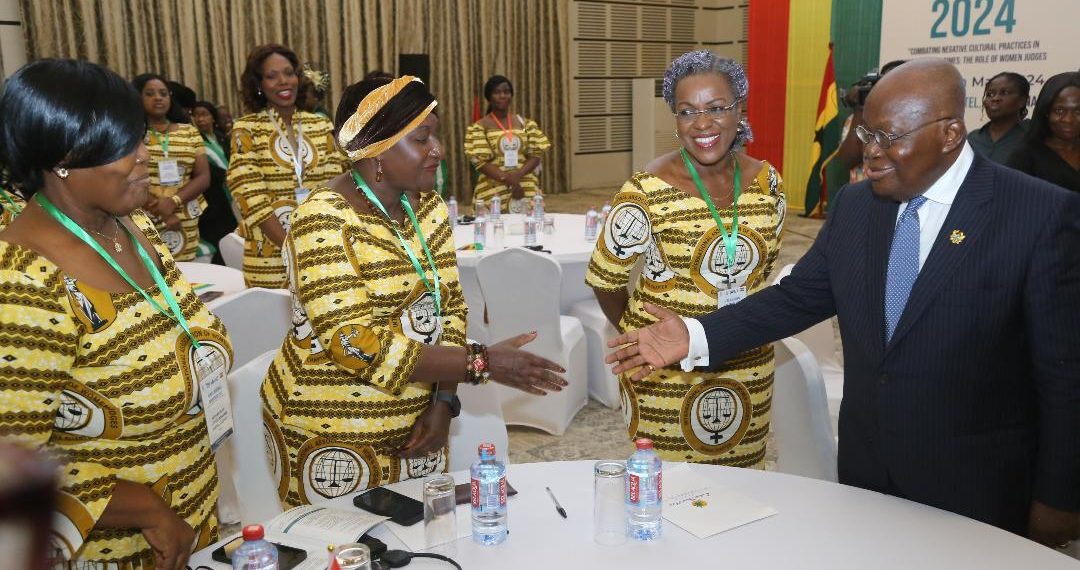
President charges female judges to help remove barriers to justice
By DL News
Published
Updated
1 min read
He emphasized their pivotal role in reshaping norms and setting legal precedents that safeguard the rights of the vulnerable and marginalized.
President Nana Addo Dankwa Akufo-Addo has charged women judges to utilize their legal expertise in breaking down barriers to justice.
He emphasized their pivotal role in reshaping norms and setting legal precedents that safeguard the rights of the vulnerable and marginalized.
The President also underscored the importance of ensuring that their judgments consistently reflect principles of fairness, equality, and justice.
Speaking at the inauguration of the 18th Africa Regional Conference of the International Association of Women Judges (IAWJ) in Accra, President Akufo-Addo addressed a diverse audience of women judges from various African nations.
The conference theme, "Combating negative cultural practices in contemporary times: The role of women judges," underscored the crucial mission of the association in promoting gender equality, ending discriminatory laws, and advancing human rights.
The President highlighted the urgency of addressing harmful cultural practices such as female genital mutilation, emphasizing that legal action alone is insufficient.
He stressed the importance of education, awareness, and collaborative efforts in combating such practices, noting that societal beliefs are molded in schools, homes, and community gatherings.
President Akufo-Addo reaffirmed the government's commitment to supporting the judiciary, citing ongoing efforts to establish courthouses nationwide.
He announced progress on the initiative, with 79 courts already inaugurated and operational, and pledged to complete the remaining 21 before the end of his tenure.
On her part, Chief Justice Gertrude Sackey Torkornoo echoed the President's sentiments, emphasizing the judiciary's duty to uphold human rights and protect women from exploitation and harmful traditions.
She advocated for the implementation of policies that promote gender equality and support the vulnerable in society.
Under her leadership, initiatives like the Chief Justice’s mentoring program and the establishment of clubs in senior high schools aim to foster a culture of empowerment and justice.